
Arrest Warrants in Wilbarger County
Texas Code of Criminal Procedure Article 15.01 spells it out. An arrest warrant is a written order from a magistrate, directed to a peace officer or another named person. The paperwork usually begins with a sworn complaint or affidavit. A judge or magistrate then weighs the legal basis. A clerk keeps the record but does not decide probable cause. In Wilbarger County, the JP page lists arrest warrants among magistrate duties, and the 46th District Court handles felony matters. The Sheriff's Office posts no countywide warrant list, so the record stays with the court or clerk that owns the case.
Article 15.02 Sets the Wilbarger Arrest Warrant's Core Fields
Think of a public warrant copy as a court document, not a live screen. Article 15.02 sets the required parts. The warrant must run in the State's name. It must identify the person or describe them with reasonable certainty. It must state the offense and carry the magistrate's signature. Beyond that, the case file can hold other papers, such as a cause number, an issue date, bond action, or a service return that ties the order to its execution. Wilbarger County has published no sample warrant and no standard number format. Nor is there a shared status legend. So a missing field in a third-party entry does not invalidate the court's record in Wilbarger County. Read the Chapter 15 text for the legal form itself. Then ask the issuing court about the actual record. The fields described here are a reading aid. They are not a claim that every Wilbarger County case prints the same way.
A court copy may also contain entries made after the order was issued.
What a Wilbarger County Arrest Warrant Contains
A useful warrant copy names the issuing court, the cause number, the charge, the issue date, and the magistrate. Those fields anchor the search. Some files add an affidavit. A return may show later execution. The affidavit may not be public before execution; Article 15.26 governs the public filing of the executed warrant and affidavit. Ask the Wilbarger County clerk for the filed document and its date, rather than trusting a commercial summary that may omit service. Use the copy to link order, issuer, and charge. Wilbarger County publishes no countywide status code. Confirm each item with the court, because no local warrant-number pattern was published either.
| Case identifier | Format not published Ask for the cause number. |
|---|---|
| Subject | Name or a reasonably definite description under Article 15.02. |
| Charge | Offense named in the warrant and supporting case record. |
| Issuing authority | Magistrate or judge and the court or clerk maintaining the file. |
| Bond / release | Amount or action if set; confirm the current order with the court or jail. |
| Issue / return | Issue date and later officer return or recall entry, if available. |
Wilbarger District Clerk Keeps Felony Warrant Files
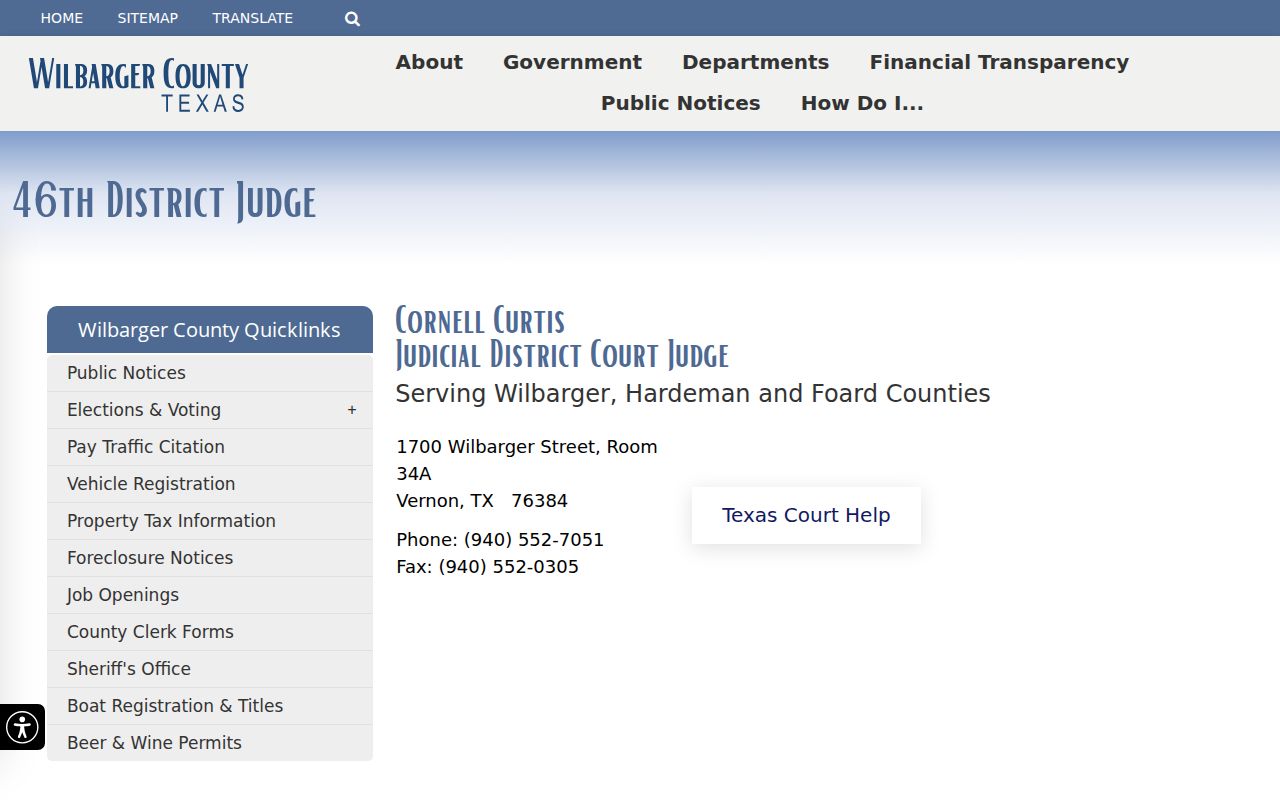
Wilbarger County felony files start with the District Clerk. Brenda Peterson holds the office, in Room 33 at the courthouse, at (940) 553-3411. The 46th District Court judge is Cornell Curtis. His courtroom sits in Room 34A, with a separate published phone number. The court serves Wilbarger, Hardeman, and Foard counties. So give the county and cause number, not just a surname. A record request and the court's hearing calendar are separate asks. The clerk's office keeps felony criminal case files, and its county page notes the office may issue capias documents. For a 46th District Court case, the clerk can identify the record it maintains. The court coordinator can route questions about a setting. The clerk will not choose your legal strategy. Nor will the office say whether to surrender. Begin at the District Clerk page or the 46th District Court page. Confirm the county and cause number before assuming a file belongs to Wilbarger County alone.
Use a written records request when you need a specific existing document.
How Wilbarger Arrest Warrants Are Served
Wilbarger County lists its Sheriff, two constables, and Vernon Police as the local law-enforcement offices. None of them publishes a case-by-case service chart. Do not assume a given officer holds the paper. General law-enforcement duties do not assign a particular warrant, so the serving agency has to be confirmed directly. Texas law lets any peace officer execute a warrant anywhere in the state. After an arrest, Chapter 15 requires prompt presentation before a magistrate, generally within 48 hours, along with the required warnings. The jail then handles custody and bond routing. The issuing court keeps control of the charge and later settings. A jail roster entry is not the warrant itself. Getting out of custody is not the same as recall of the underlying warrant. Only the issuing court can recall or quash its process. If you are checking on a warrant in Wilbarger County, ask the court rather than the jail log. Details for a specific case stay with the agencies. Wilbarger County offices will confirm their own files.
Wilbarger JPs Also Issue Arrest Warrants
Felonies do not corner the market on arrest warrants in Wilbarger County. The local justice courts handle them too. Published JP materials describe magistrates issuing arrest and search warrants, and blood warrants as well. That means a misdemeanor or traffic matter might sit in a precinct docket rather than with the District Clerk or the Vernon municipal court. Each office keeps its own citation and cause records, separate from one another. Before calling around, figure out which precinct holds the file, JP1 or JP2. The Justice of the Peace page gives both offices, their suites, and phone lines. Only the court itself can confirm it owns the case; a law-enforcement page will not answer docket questions.
Wilbarger County Arrest Warrant vs Summons vs Bench Warrant
Three different papers, three different jobs. A summons orders someone to appear in a Wilbarger County court without an arrest. A bench warrant, often tied to failure to appear, answers a missed setting in a case already open. An arrest warrant starts with a sworn statement and a magistrate's signature. Learn which one controls your case, and if a court date was missed, the bench-warrant record route explains the next move.
| Feature | Arrest Warrant | Summons | Bench Warrant |
|---|---|---|---|
| What it orders | Take the named person into custody | Appear at a stated time | Arrest for a missed court duty |
| Basis | Sworn complaint or other legal basis | Authorized notice process | Failure to appear or comply |
| Issuer | Judge or magistrate | Court or officer where authorized | Judge in the existing case |
| Next step | Confirm status and ask counsel about bond or surrender | Follow the appearance instructions | Call the court that set the date |
Wilbarger County Warrant Service Roles Are Published, Assignments Are Not
Wilbarger County splits warrant work across a few offices. The Sheriff's Office posts its duties as service of process and court security. Constables for Precincts 1 and 2 share a courthouse contact block. Vernon Police runs 24 hours a day, yet its public page offers no city-warrant portal and no service matrix. So you can spot which agency might carry a warrant, but not the officer tied to one case. For that, call the issuing court and ask which agency took the process. Then ask that agency about service or custody. A separate jail call may still be needed after a booking, and the officer who serves an order cannot record a recall; only the judge or clerk can.
Public Access to Executed Wilbarger Arrest Papers
Once an arrest warrant is executed, the paper trail opens up. Texas Code of Criminal Procedure Article 15.26 makes the warrant and its supporting affidavit public after return and filing. The case's clerk can explain inspection, copies, and the copying charges. There are limits, though. The rule does not open unexecuted warrants, investigative files, or sealed records to the public. In Wilbarger County, a district court case starts with the District Clerk, while another issuing court may keep its own file. A clerk hands you the court record. Choosing your next legal step is a question for a lawyer.
What to Do If There Is a Wilbarger Arrest Warrant
Found a Wilbarger County arrest warrant in your name? Work in the right order. First confirm the issuing court, the process type, its status, and any other hold before you walk in. Then talk with a criminal-defense attorney about a surrender arrangement, bond, or a motion to recall or quash. Wilbarger County has published no walk-in protocol or bond schedule. That means the court and the jail must confirm where to go, what payment is accepted, and what release means for the case. After any payment, arrest, bond, or appearance, get the next court date in writing. For more detail, see the Wilbarger County warrant steps.
Important: Speak with counsel and the issuing court before appearing; the county has not published a walk-in surrender or same-day release promise.